How to
Avoid Being Short-Charged When Buying Timber
This guide explains how to avoid being short-charged when purchasing sawn timber. Checking only the number and length of the pieces is not sufficient. The width and thickness are equally important, as even a small reduction in either dimension can significantly reduce the total volume of timber supplied. This is particularly important for sawn timber used in cargo securing, industrial packing, cradles, dunnage, skids and other heavy-duty applications.
1. Check
the Actual Dimensions
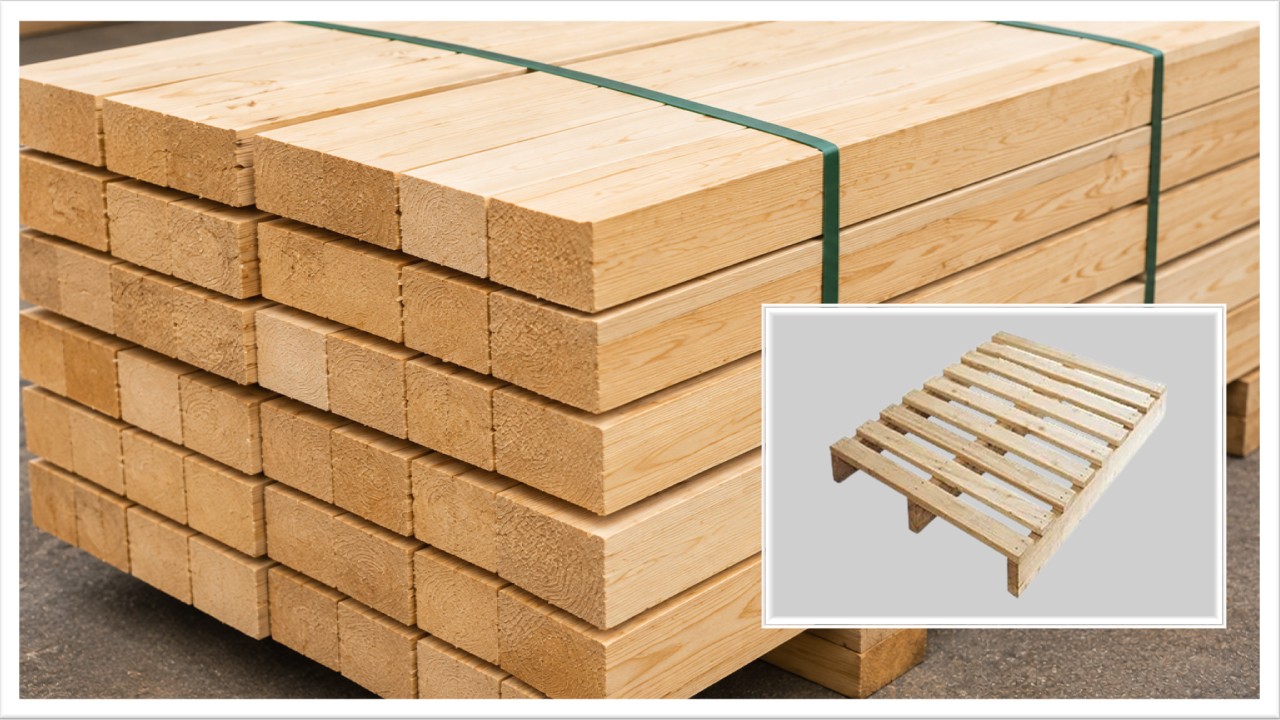
A common timber size used for cargo securing
is: 100mm
(4 inch) × 100 (4 inch) × 4,000 mm ( 13.2 ft/4 meters)
Please remember:
1 inch = 25.4 mm
Therefore:
4 inches = 101.6 mm
In commercial transactions, 4 × 4-inch timber
may be described as 100 × 100 mm.
Your purchase order should clearly state
whether the quoted dimensions are nominal sizes or the minimum actual
dimensions required.
Recommended specification:
Timber size: 100 × 100 × 4,000 mm, actual dimensions, with a max tolerance
of ±1 mm - ±3 mm , no negative tolerance above this unless
approved by the buyer in writing.
2. Do Not
Check the Length Alone
Consider 25 pieces of timber measuring 100 ×
100 × 4,000 mm.
First, convert the dimensions into metres:
Width: 100 mm ÷ 1,000 = 0.1 m
Thickness: 100 mm ÷ 1,000 = 0.1 m
Length: 4,000 mm ÷ 1,000 = 4 m
The volume of one piece is:
0.1 × 0.1 × 4 = 0.04 m³
The volume of 25 pieces is:
0.04 × 25 = 1.00 m³
Therefore, 25 pieces of 100 × 100 × 4,000
mm timber equal one cubic metre.
Now suppose the supplier invoices you for this
size but supplies 75 × 75 × 4,000 mm pieces instead.
Convert the dimensions into metres:
Width: 75 mm ÷ 1,000 = 0.075 m
Thickness: 75 mm ÷ 1,000 = 0.075 m
Length: 4,000 mm ÷ 1,000 = 4 m
The volume of one piece is:
0.075 × 0.075 × 4 = 0.0225 m³
The volume of 25 pieces is:
0.0225 × 25 = 0.5625 m³
Although the quantity and length are correct,
you have received only 0.5625 m³ instead of 1 m³.
|
|
|
|
||||||||||||||||||
|
|
|
|
You have therefore received:
1.0000 − 0.5625 = 0.4375 m³ less timber
0.4375 ÷ 1.0000 × 100 = 43.75% shortage
If one cubic metre
costs ₹38,865:
₹38,865 × 0.5625 =
₹21,861.56
₹38,865 − ₹21,861.56 =
₹17,003.44 difference
Therefore, you have
paid ₹38,865 but received timber worth only ₹21,861.56 at the
same cubic-metre rate.
3. Measure
Before Accepting Delivery
Use a measuring tape or vernier calliper to
check the width and thickness. Measure randomly selected pieces from different
bundles, not only those placed on top.
Take measurements at several points because
timber can be tapered or uneven. If different sizes have been supplied,
calculate the volume of each size separately.
4. Why Kiln
Drying at Source Is Better
Where possible, timber should be kiln-dried at
the sawmill soon after cutting.
Kiln drying at source provides better control
over the timber’s origin, species, cutting date, initial moisture content and
drying schedule. It also reduces exposure to rain, direct sunlight, humidity,
insects and uncontrolled storage.
Timber sent to a sales yard before kiln drying
may remain exposed for 30–60 days or longer. During this period, green timber
can develop:
Later kiln drying may reduce the moisture
content, but it cannot necessarily reverse damage that has already occurred.
Kiln drying at the sale point can still be
acceptable when carried out by a properly equipped facility. Ask for:
Even correctly kiln-dried timber can absorb
moisture again during transport or outdoor storage. Always check the moisture
content and physical condition when the timber is delivered.
5.
Understand Kiln Drying and ISPM 15
Kiln drying and ISPM 15 treatment are often
confused, but they have different purposes.
Kiln Drying
Kiln drying primarily reduces the timber’s
moisture content. It helps improve dimensional stability and reduce shrinkage,
warping, splitting and moisture-related deterioration.
The required final moisture content should be
clearly stated in the purchase order.
ISPM 15
Treatment
ISPM 15 is an international phytosanitary
standard for wooden packaging used in international trade, including pallets,
crates, packing blocks and dunnage.
Its purpose is to reduce the international
spread of plant pests—not to guarantee low moisture content or structural
quality.
Under conventional ISPM 15 heat treatment, the
entire timber profile, including its core, must reach at least:
56°C for 30 continuous minutes
Compliant timber must be treated under an
authorized system and carry the appropriate IPPC mark.
Likewise, ISPM 15-treated timber is not
necessarily adequately kiln-dried. The timber may satisfy the phytosanitary
requirement while still containing more moisture than the buyer requires.
Timber-Buying
Checklist
Before accepting a timber delivery, verify:
Final
Advice
Never purchase timber based only on
appearance, length or piece count. Always calculate:
Width × Thickness × Length × Quantity = Total
Timber Volume
A reduction from 100 × 100 mm to 75 × 75 mm
may not appear substantial, but it means receiving 43.75% less timber.
© Jaina Maritime Solutions, All Rights Reserved | Design By Mplussoft